Cool Drawings of the Devil
Whether yous call him Satan, Lucifer, or Mephistopholes, he'southward a beast with fifty-fifty more faces than he has names. Over the past 5 centuries, artists take variously depicted the devil as a fanged, horned demon; every bit an armored, Apollo-similar ground forces leader; and as a tailor of Nazi uniforms. A new exhibition at Stanford's Cantor Art Heart, Sympathy for the Devil: Satan, Sin and the Underworld, presents forty works from 500 years of artistic portrayals of history's virtually famous fallen angel, along with his minions and his evil realm.
"Obviously, people are more than fascinated with evil than with good," curator Bernard Barryte tells Co.Design. "Just await at the TV shows and movies from the final several seasons–there's a natural human curiosity nearly horror." In the earlier depictions of Satan, hailing from the 1500s and 1600s, this intrigue with horror is projected onto an image of a bestial, inhuman demon. Simply as the centuries become on, artists start rendering the personification of evil as, well, one of us. How did Satan's image evolve from that of a caprine animal-like demon to more like your adjacent door neighbor? How exercise artists decide what the devil looks like?
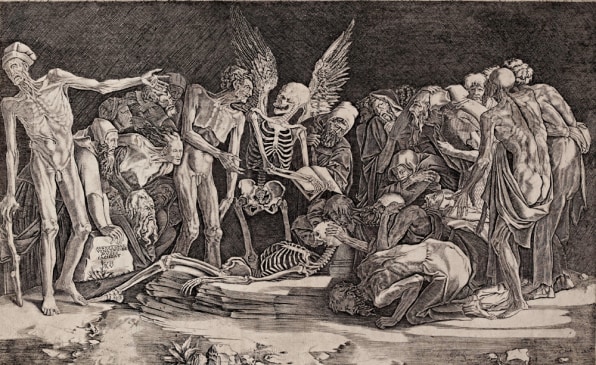
In the Middle Ages, artists who wanted to draw Satan–amidst them, Hieronymus Bosch, Albrecht Dürer, and Hendrick Goltzius, all from Germany–were given surprisingly few details from the Bible about how he should appear. "The Bible is very vague," Barryte says. To visualize this ruler of Hell, artists cobbled together imagery from older traditions that had already decided what demons looked similar. "Bits and pieces from lots of at present-defunct religions got synthesized: The cloven anxiety from Pan, the horns from the gods of various cults in the about east," Barryte says. "In the 15th and 16th century, these solidified into this personification of evil, seen every bit the great enemy of Christ, the Church, and mankind: a horned, unmerciful, hirsuite effigy."
Literature, too, has e'er had a major influence on how artists choose to represent Lucifer: in the Middle Ages, Dante's Inferno, from the 14th century, provided the nigh graphic descriptions of the animate being that lay in the innermost circle of Hell. In one paradigm on view by Cornellus Gall, Satan appears exactly as Dante described him: standing upright, his lower half buried in a ocean of water ice, with 3 faces, munching on the three greatest traitors–Judas Iscariot, Brutus, and Cassius. "He stares straight out at you with his foremost face," Barryte says. "Graphically, it'south a very powerful image."
In subsequently centuries, depictions of Satan in art evolved from a wretched fauna to a more man figure. "Past the 18th century, he'southward ennobled, nigh looking like an Apollo," Barryte says–as seen in Thomas Stothard's "Satan Summoning His Legions," from 1790. That was due to the aftermath of the French and American revolutions, which tried to excise the more than superstitious elements of religion. "People interpreted the figure less as demonic creature and more than as heroic rebel against the oppression of the paternal god," Barryte says. These renderings were also influenced past John Milton's Paradise Lost, several editions of which are on view hither, which drew Satan as an almost pitiable tragic hero.
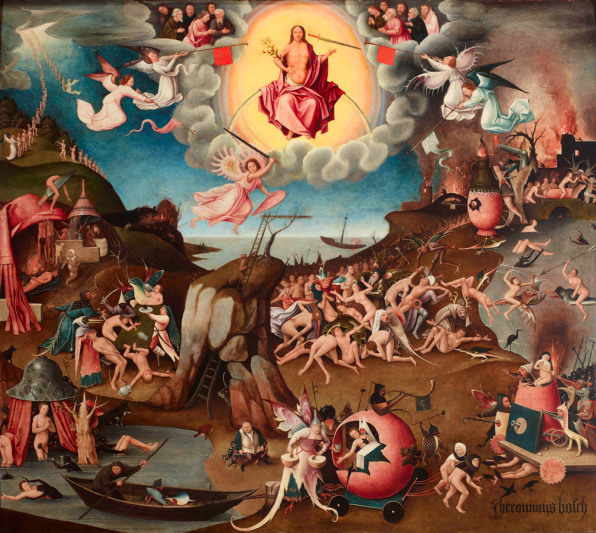
In the 19th century, the publication of Goethe'south Mephistopholes in Faust and Mark Twain'due south Mysterious Stranger influenced artists to portray Satan as much more of "a sly, cunning, dandyish blazon of effigy," every bit Barryte says. "Instead of scaring people into sin and intimidating them, he now uses persuasion." And he has to await advisable for the part: more weasely than unmerciful. In the exhibit, this trickster side of Satan is seen in a statuary statue depicting him as Mephistopholes, by the artist Ude.
While the image of Satan as a red, winged, horned effigy persists in today'southward popular imagination, contemporary artists have bestowed the devil with the nigh man likenesses to date. Barryte says the piece he finds most disturbing is Andres Serrano's 1984 photograph, "Heaven and Hell" (NSFW). "It shows a nude women strung up and bloodied. With his dorsum to her is this stern, stony faced cardinal, who has conspicuously tortured her in some way," Barryte says. The image as far more ambiguous than earlier, more primitive depictions of an plain evil creature. In the 20th century, equally traditional religious structures broke down, artists started pointing out that evil might even lie within the church building that so vehemently claims to oppose it. "The photograph asks so many questions almost the church building's view of sexuality, and what is heaven, what is hell, where does evil actually prevarication, why is it perpetrated?" Barryte says.
In Jerome Witkin's 1978 painting "The Devil as Tailor," Satan portrayed non equally a standard devil at all, but as an ordinary-looking person sewing uniforms for the Nazis during World State of war Two. "Hanging around him in lurid lighting are SS uniforms, prisoner uniforms," Barryte says. It'due south a comment on the "banality of evil," as philosopher Hannah Arendt put it in her descriptions of Nazism. "The devil has become u.s.a., in a fashion," Barryte says. "He's less personified as some evil fauna. It's the human who creates hell on Earth."
[h/t the Wall Street Periodical]
Source: https://www.fastcompany.com/3034309/the-changing-face-of-satan-artistic-depictions-of-the-devil-1500-to-today
0 Response to "Cool Drawings of the Devil"
Post a Comment