How Health of Hispanic Ethnic Families Affected Society
The coronavirus outbreak has contradistinct life in the United states of america in many ways, but in key respects information technology has affected black and Hispanic Americans more than others.
The financial shocks of the outbreak have striking Hispanic and black Americans especially difficult. When it comes to public wellness, blackness Americans appear to account for a larger share of COVID-19 hospitalizations nationally than their share of the population. And in New York Urban center, death rates per 100,000 people are highest among blacks and Hispanics.
As the coronavirus sweeps through the country, Pew Inquiry Center has been surveying Americans to explore its touch on on their lives. The surveys have revealed notable racial and ethnic differences in experiences with the disease or expiry of loved ones, as well as job losses and pay cuts. At that place is also new evidence of long-standing differences among racial and ethnic groups, in some cases tied to underlying economic, geographic and health circumstances.
Here are some key findings about race, ethnicity and the COVID-19 outbreak, drawn from surveys conducted during the commencement months of the crunch.
This post is based on findings from two Pew Research Centre surveys. The Center surveyed 11,537 U.S. adults from March nineteen to 24, 2020, nearly economic, health and other worries every bit the coronavirus began to spread in the U.S. The Center and then surveyed 4,917 U.Southward. adults from April 7 to 12, 2020, almost economic issues and wellness concerns during the outbreak.
Everyone who took part in both surveys is a member of Pew Research Center'due south American Trends Console (ATP), an online survey panel that is recruited through national, random sampling of residential addresses. This way nearly all U.S. adults have a gamble of selection. The surveys are weighted to be representative of the U.S. developed population by gender, race, ethnicity, partisan affiliation, education and other categories. Read more most the ATP'southward methodology.
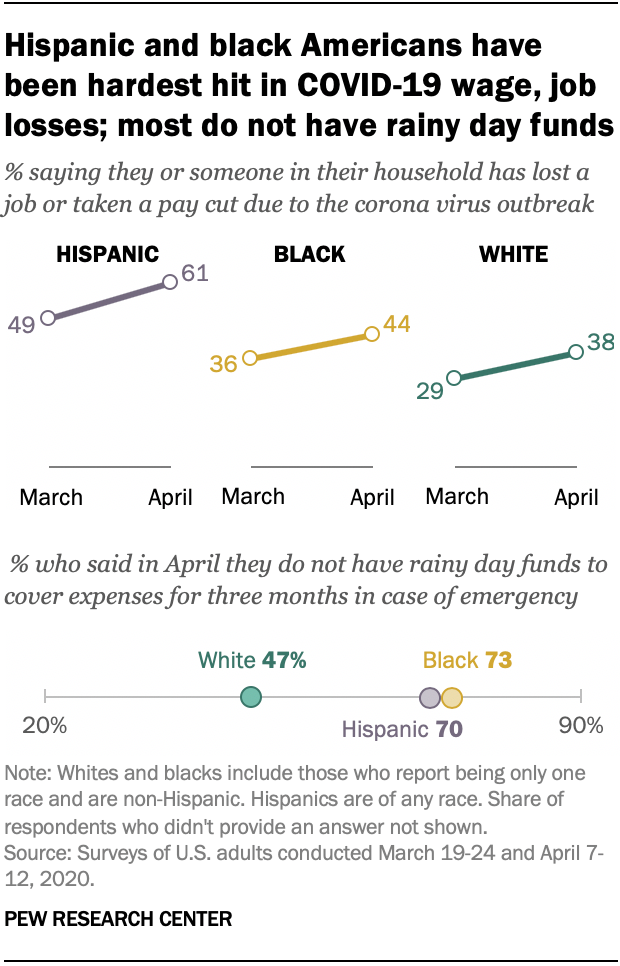 1Chore and wage losses due to COVID-nineteen have striking Hispanic adults the hardest. Some 61% of Hispanic Americans and 44% of black Americans said in Apr that they or someone in their household had experienced a job or wage loss due to the coronavirus outbreak, compared with 38% of white adults. These shares were upwards from a March survey, when 49% of Hispanics, 36% of blacks and 29% of whites said their household had experienced a job or wage loss.
2About black and Hispanic Americans do not have financial reserves to cover expenses in case of an emergency. In the April survey, nearly three-quarters of black (73%) and Hispanic adults (70%) said they did non have emergency funds to cover three months of expenses; effectually half of white adults (47%) said the same. The vast majority of black and Hispanic adults without fiscal reserves also said they would not be able to cover their expenses for 3 months by borrowing money, using savings or selling assets.
In the aforementioned survey, 57% of black adults and 51% of Hispanic adults said the federal assist package passed in response to COVID-19 would help their household at least a fair amount. Some 43% of white adults said the same.
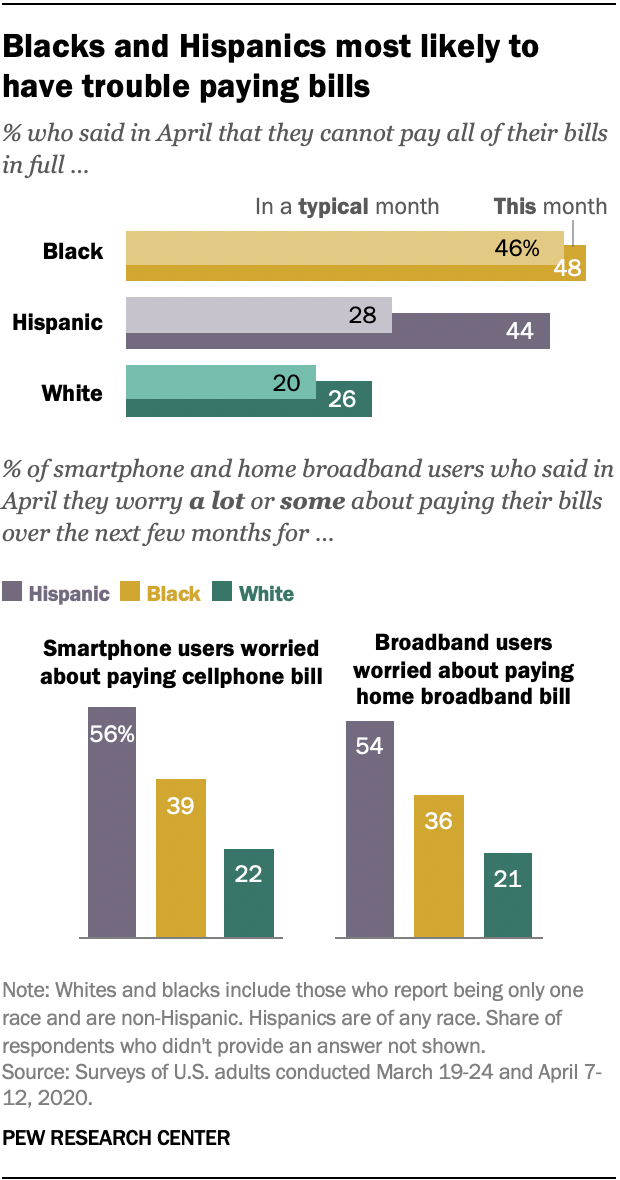 threeThe COVID-19 economic downturn has made it harder for some Americans to pay their monthly bills. Blackness (48%) and Hispanic adults (44%) were more likely than white adults (26%) to say they "cannot pay some bills or can just brand partial payments on some of them this calendar month," according to the Apr survey. For Hispanics, this was a considerably greater share than the 28% who said they have trouble paying their bills in a typical month.
These concerns extended to paying cellphone and home broadband bills. Hispanic and blackness adults who use these technologies were more likely than white users to say they worry a lot or some almost paying bills for these services.
fourThere are precipitous racial and ethnic differences in personal experiences with COVID-19 and in concerns about spreading or catching the virus. In the April survey, nearly one-in-four black adults (27%) said they personally knew someone who had been hospitalized or died as a outcome of having COVID-xix, roughly double the shares who said this among Hispanic or white adults (xiii% each). At the same time, Hispanic Americans expressed greater concern than other groups about contracting COVID-19 and requiring hospitalization. Hispanics were too more likely than blacks or whites to be worried that they might unknowingly spread COVID-19 to others; well-nigh ii-thirds of all adults said they were at least somewhat concerned near doing this.
fiveHispanic and blackness Americans are more likely than white adults to say cellphone tracking is acceptable in efforts to fight the virus. Two-thirds (66%) of Hispanic adults and 56% of blackness adults said in Apr that it is at to the lowest degree somewhat acceptable for the government to use people's cellphones to track the location of those who accept tested positive for the coronavirus; about half of white Americans (47%) said the same. Hispanic (55%) and black adults (45%) were also more than likely than white adults (31%) to say it is very or somewhat acceptable for the government to rail the location of people's cellphones to ensure people are complying with experts' advice on limiting social contact during the outbreak. The findings come equally some governments have considered employing technology to help with monitoring and tracking the spread of the virus.
Despite their greater support for cellphone tracking in this context, 62% of blacks and 47% of Hispanics even so said in April that cellphone tracking will non make much of a difference in limiting the spread of COVID-nineteen.

Mark Hugo Lopez is managing director of race and ethnicity research at Pew Inquiry Center.

Lee Rainie is manager of cyberspace and technology enquiry at Pew Research Center.
Abby Budiman is a old inquiry annotator focusing on race and ethnicity inquiry at Pew Enquiry Center.
Source: https://www.pewresearch.org/fact-tank/2020/05/05/financial-and-health-impacts-of-covid-19-vary-widely-by-race-and-ethnicity/
0 Response to "How Health of Hispanic Ethnic Families Affected Society"
Post a Comment