If the Collision Is Totally Inelastic, What Can You Say About the Motion After the Collision?

A bouncing ball captured with a stroboscopic flash at 25 images per second. Each impact of the ball is inelastic, meaning that energy dissipates at each bounce. Ignoring air resistance, the square root of the ratio of the height of one bounciness to that of the preceding bounce gives the coefficient of restitution for the ball/surface touch.
An inelastic collision, in contrast to an elastic collision, is a collision in which kinetic energy is not conserved due to the action of internal friction.
In collisions of macroscopic bodies, some kinetic energy is turned into vibrational energy of the atoms, causing a heating effect, and the bodies are plain-featured.
The molecules of a gas or liquid rarely experience perfectly elastic collisions because kinetic energy is exchanged between the molecules' translational motion and their internal degrees of liberty with each collision. At any one instant, one-half the collisions are – to a varying extent – inelastic (the pair possesses less kinetic energy after the collision than before), and one-half could be described as "super-elastic" (possessing more kinetic free energy after the collision than before). Averaged across an entire sample, molecular collisions are elastic.[ commendation needed ]
Although inelastic collisions do non conserve kinetic energy, they do obey conservation of momentum.[ane] Simple ballistic pendulum bug obey the conservation of kinetic energy only when the block swings to its largest angle.
In nuclear physics, an inelastic collision is one in which the incoming particle causes the nucleus it strikes to get excited or to intermission up. Deep inelastic scattering is a method of probing the structure of subatomic particles in much the same way as Rutherford probed the inside of the atom (run across Rutherford scattering). Such experiments were performed on protons in the late 1960s using high-energy electrons at the Stanford Linear Accelerator (SLAC). As in Rutherford scattering, deep inelastic handful of electrons by proton targets revealed that most of the incident electrons collaborate very niggling and laissez passer directly through, with only a small number bouncing back. This indicates that the accuse in the proton is concentrated in small lumps, reminiscent of Rutherford's discovery that the positive charge in an cantlet is full-bodied at the nucleus. However, in the case of the proton, the show suggested three distinct concentrations of accuse (quarks) and not one.
Formula [edit]
The formula for the velocities afterwards a one-dimensional collision is:


where
- v a is the final velocity of the first object after touch on
- v b is the final velocity of the 2d object later on impact
- u a is the initial velocity of the first object before impact
- u b is the initial velocity of the second object before bear on
- m a is the mass of the kickoff object
- one thousand b is the mass of the second object
- C R is the coefficient of restitution; if it is 1 we have an rubberband standoff; if it is 0 we take a perfectly inelastic collision, meet below.
In a center of momentum frame the formulas reduce to:


For two- and 3-dimensional collisions the velocities in these formulas are the components perpendicular to the tangent line/plane at the signal of contact.
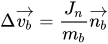
The normal impulse is:

Giving the velocity updates:

Perfectly inelastic collision [edit]

A completely inelastic collision between equal masses
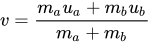
A perfectly inelastic collision occurs when the maximum amount of kinetic free energy of a system is lost. In a perfectly inelastic standoff, i.e., a null coefficient of restitution, the colliding particles stick together. In such a standoff, kinetic energy is lost past bonding the 2 bodies together. This bonding energy usually results in a maximum kinetic energy loss of the system. It is necessary to consider conservation of momentum: (Note: In the sliding block case above, momentum of the two trunk system is only conserved if the surface has null friction. With friction, momentum of the 2 bodies is transferred to the surface that the ii bodies are sliding upon. Similarly, if in that location is air resistance, the momentum of the bodies tin can be transferred to the air.) The equation below holds true for the two-torso (Body A, Body B) system collision in the case above. In this example, momentum of the system is conserved because there is no friction betwixt the sliding bodies and the surface.

where five is the concluding velocity, which is hence given past

Some other perfectly inelastic collision
The reduction of total kinetic free energy is equal to the full kinetic energy before the collision in a eye of momentum frame with respect to the system of two particles, because in such a frame the kinetic free energy after the standoff is zero. In this frame almost of the kinetic free energy before the collision is that of the particle with the smaller mass. In another frame, in addition to the reduction of kinetic energy there may be a transfer of kinetic energy from ane particle to the other; the fact that this depends on the frame shows how relative this is.
With time reversed nosotros take the situation of ii objects pushed away from each other, due east.g. shooting a projectile, or a rocket applying thrust (compare the derivation of the Tsiolkovsky rocket equation).
Partially inelastic collisions [edit]
Partially inelastic collisions are the well-nigh mutual course of collisions in the real world. In this type of collision, the objects involved in the collisions do not stick, but some kinetic free energy is however lost. Friction, sound and heat are some ways the kinetic free energy tin exist lost through partial inelastic collisions.
References [edit]
- ^ Ferdinand Beer Jr. and Eastward. Russell Johnston (1996). Vector equations for engineers: Dynamics (6th ed.). McGraw Hill. pp. 794–797. ISBN978-0070053663.
If the sum of the external forces is zero ... the total momentum of the particles is conserved. In the full general case of touch, i.e., when e is not equal to 1, the total free energy of the particles is not conserved.
Source: https://en.wikipedia.org/wiki/Inelastic_collision
0 Response to "If the Collision Is Totally Inelastic, What Can You Say About the Motion After the Collision?"
Post a Comment